Over the past 10 days, I have been walking from village to village in Nepal. We started in the small town of Shivalaya and finished in the larger town of Phaplu. With us was a team of ten sherpas. Sherpas are a cultural Nepali group known for their strength and mountain skills. We travelled through mountains and villages along small remote trails used for local transportation, as there are few roads in rural Nepal. Along our travels, I was most impressed by the lifestyle of the Nepali people, the unique Nepali culture, and the experience of traveling with a team of Sherpas.
 |
| Shivalaya |
 |
| Starting in Shivalaya |
 |
| Looking down on Our Second Night's Stay |


One of the coolest cultural experiences on the trek was the Dashain Hindu Festival. On our second night, we camped in a small Hindu village. This happened to be the first night of the Dashain festival and we were invited in to a Hindu family's house. There we were served tea, cucumber, and potatoes. We did not realize that the cucumbers were raw. The father of the household blessed us with the Tika. He patted a traditional pink sticky substance on our foreheads. This was made out of rice, corn, sugar and pink dye. He wished us good luck on our journey while placing the traditional Tika on our foreheads. We later learned that on the first night of the festival all of the townspeople go from house to house receiving the Tika blessing.
 |
| The Tika Blessing |
 |
| A Tradition of the Hindu Festival to Bless the Tires |
 |
| Dad Swinging on a Traditional Festival Swing |

Staying healthy was one of the hardest parts of the trek. We learned this the hard way. During the Dashain festival, I ate raw cucumber. The next morning, I felt sick to my stomach and vomited many times. I still had to endure a three hour steep, uphill hike, while having occasional squirts of diarrhea. We all had this happen to us several times throughout the trek and always brought the toilet paper along with us on the trail.
Another interesting cultural experience was visiting the local tea houses. All along the trail, we stopped to drink tea with the local people in their houses. Inside tea houses, the family would serve us traditional milk tea. The tea tasted sweet, milky and very different from American teas. Along the trail we also saw traditional yak herding huts made of rocks without roofs. The herders use a tarp and pieces of wood to make a roof for the huts. Some huts were inhabited and others deserted. Some were being used for storing yaks or dogs. One of my favorite cultural experiences was drinking tea inside a yak herder’s stone hut. The floor was covered with juniper branches and the herder made a fire and cooked us tea.


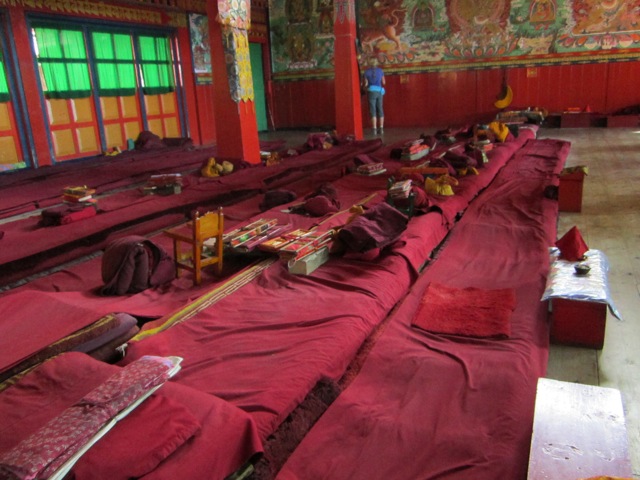
I also found the many beautiful monasteries we visited along the way to be very interesting. On the walls were pantings, fascinating but unknown to us. On the floor were mattresses on which the monks would kneel and pray. In the front of the room was usually a big golden statue of Buddha. In the monasteries, there were other buildings used as sleeping quarters for the monks. We also visited one nunnery. It was almost exactly like the monasteries. As we walked through the nunnery, a nun dressed in red and yellow robes, with a shaved head, gave me a bag of blessed cookies which gave us energy later in the day.
 |
| The Nunnery |
 |
| Inside The Nunnery |
 |
| Exiting a Monastery |
Rural life in Nepal is hard work. Along the trail, we passed many small farms and roaming live stock. The standard farming animals were goats, sheep, cows, chickens, buffalo, and yaks. The farms were small with terraces growing corn, barley, wheat, and lettuce. The farmers do their work by hand, including separating corn, tilling the soil with cows, and carrying the wheat on their backs. In the mountains, we saw people herding yaks and living in yak huts.


Treking with Sherpas was hard but fun. Every day we hiked for eight to ten hours, waking up at six, and arriving at camp at four or five. In the morning, we were served tea and a western breakfast. We would have liked to eat the Nepali food so that our Sherpa cook would not have to make two meals and we could eat like a true Nepali. However, even after asking many times, we still had eggs and pancakes for breakfast while our Sherpas ate curry. We had one Sherpa guide and his assistant, one Sherpa cook and seven porters carrying all of the gear. With us was a heavy stove and a kitchen table. We did not know that this trek would involve this many porters and this much kitchen gear. The Sherpas were helpful, but it was uncomfortable to be served by so many people.
 |
| Two of Our Porters |
 |
| Some of Our Gear |
In rural Nepal, there are no roads and we followed the local paths between villages. The vegetation was mostly lush and jungly. Two of the seven days we hiked were in complete fog. You could see in front of you for a couple meters at most. One night, we camped next to a lake with an amazing view of Numbur, the holy mountain. We watched in awe as the sunset turned the mountain pink and then orange. One of the Buddhist Sherpas with us took some time to meditate as the sun set.


 |
| A View of Prayer flags by the Shrine |


Throughout our Nepal trek, I enjoyed the many cultural experiences, was impressed by the high endurance rural life style, and had mixed feelings about traveling with Sherpas. I loved my Nepali trekking experience and will now say that Nepal is one of my favorite places. The people were caring and welcoming. The hiking was hard work with spectacular views. Next time, I would travel with a smaller crew and eat Nepali food. I would also not bring the kitchen table along, and would hold the plate in my lap instead. I loved exploring monasteries and will definitely be back trekking some day soon.
Thank you for reading
Rohan Geographic!